The Memory Matrix: Demystifying HBM, LPDDR, GDDR, and the Silicon Powering Modern Tech
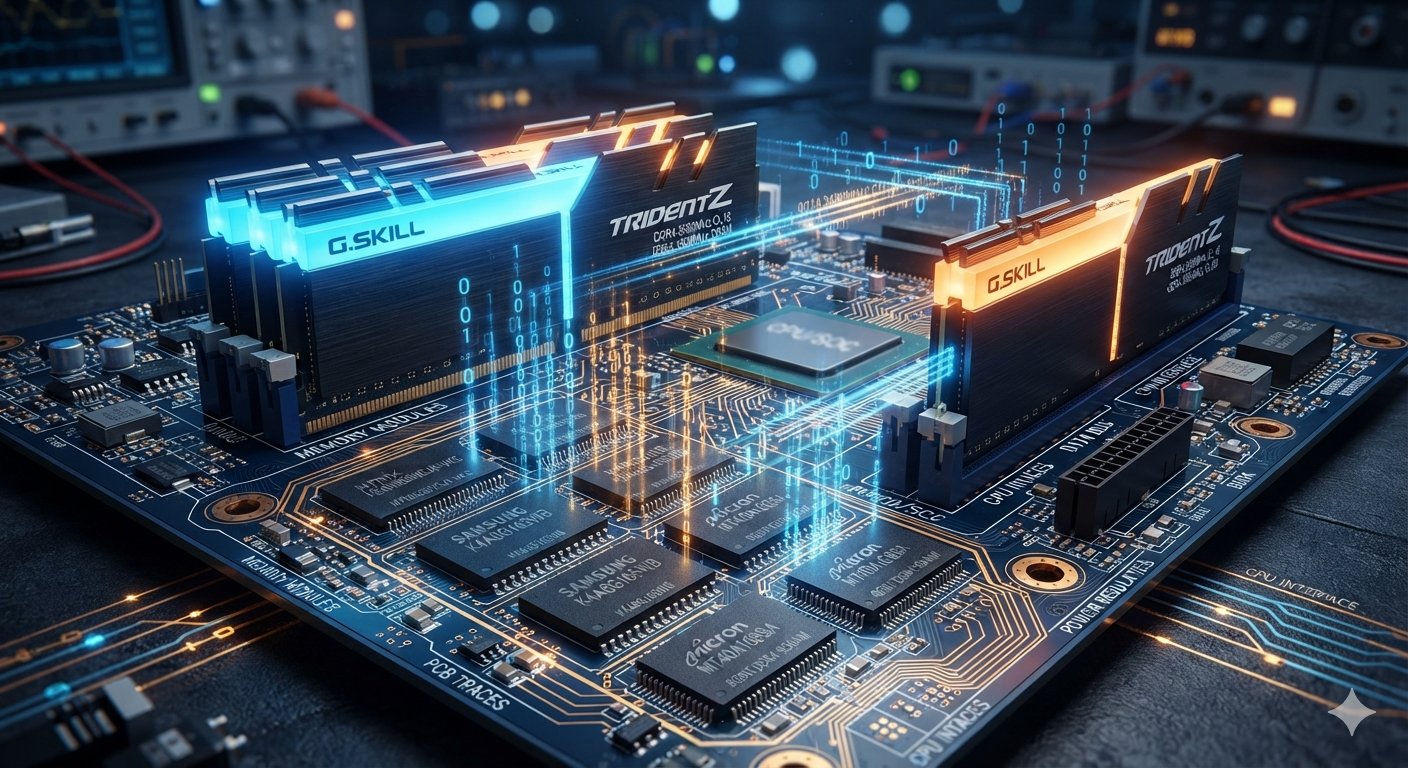
Why modern computing isn’t just about faster CPUs and GPUs—it’s a race against the memory wall.
In the early days of computing, speed was dictated almost entirely by raw clock speeds: How fast can the central processor tick?
Fast forward to 2025, and the bottleneck has shifted dramatically. Welcome to the era of the "Memory Wall." While modern compute units (CPUs, GPUs, and Neural Processing Units / NPUs) can crunch quadrillions of calculations per second, they constantly starve if data cannot be fed to them quickly enough.
Whether you’re scrolling through TikTok on your smartphone, rendering ray-traced shadows in an open-world game, or fine-tuning a trillion-parameter Large Language Model (LLM), the type of dynamic memory (RAM) used makes or breaks the experience.
Let’s unpack the alphabet soup of modern memory: DDR, LPDDR, GDDR, and HBM.
1. DDR (DDR4 / DDR5): The General-Purpose Workhorse
Found in: Desktops, standard enterprise servers, traditional workstations.
If you’ve ever built your own PC or popped open a computer case, you’re already familiar with DDR (Double Data Rate Synchronous DRAM).
How it works:
Standard DDR memory is designed for versatility. It connects to the CPU via standardized DIMM slots across a 64-bit channel per stick (split into two 32-bit subchannels in DDR5).
- Strengths:
- Modular and easily upgradeable.
- Balanced trade-off between latency, bandwidth, and cost.
- Large capacity scaling (up to multiple terabytes in dual-socket servers).
- Weaknesses:
- Relatively high power draw compared to mobile alternatives.
- Form factor is too bulky for smartphones and ultra-thin laptops.
Takeaway: DDR5 is the reliable, interchangeable standard that keeps everyday enterprise and consumer computing moving.
2. LPDDR (LPDDR5 / LPDDR5X): The Battery Whisperer
Found in: Smartphones, tablets, ultrabooks, automotive dashes, and Apple Silicon Macs.
LP stands for Low Power, and that moniker is taken seriously. Designed originally under the JEDEC standard for smartphones, LPDDR has staged a quiet coup, now dominating thin-and-light laptops.
The Secret Sauce:
Unlike standard DDR, which waits for commands over a high-voltage bus, LPDDR dynamically scales its clock speeds and voltages dramatically. When your phone is in your pocket, LPDDR slips into an ultra-low-power idle state, sipping fractions of a milliwatt.
Furthermore, LPDDR chips are usually soldered directly onto the motherboard—or integrated directly into the system-on-chip (SoC) package alongside the CPU and GPU (like Apple's unified memory architecture).
- Strengths:
- Exceptional energy efficiency.
- Ultra-short traces yield impressive peak bandwidth (LPDDR5X hits up to 8.5–9.6 Gbps per pin).
- Very compact footprint.
- Weaknesses:
- Zero upgradeability. Soldered to the board means whatever you buy is what you keep.
3. GDDR (GDDR6 / GDDR6X / GDDR7): The Raw Throughput Monster
Found in: Dedicated Graphics Cards (Nvidia RTX, AMD Radeon), Game Consoles (PS5, Xbox Series X).
Standard DDR prioritizes low latency (how fast a single read/write command completes). GDDR (Graphics DDR) flips the script: it doesn’t care as much about latency; it cares about massive bandwidth (how much data can flood through the pipes simultaneously).
Why GPUs Love It:
Rendering graphics and processing physics requires moving enormous arrays of vertex and pixel data into parallel compute pipelines. GDDR achieves this by using wider memory buses (e.g., 256-bit or 384-bit wide buses across multiple chips) and ultra-high clock speeds.
- GDDR6 / 6X: The current backbone of modern GPUs, pushing speeds from 16 Gbps up to 24 Gbps.
- GDDR7: Debuting on next-gen hardware, GDDR7 transitions to PAM3 signaling (three voltage levels instead of binary 0/1 pulses) to push bandwidth past 32 Gbps per pin without melting the card.
4. HBM (HBM3 / HBM3e / HBM4): The AI Superweapon
Found in: Data-center AI accelerators (Nvidia H100/H200/B200, AMD Instinct MI300X), advanced networking equipment.
When training and serving modern AI models, even the fastest GDDR7 memory falls short. A model with hundreds of billions of weights requires terabytes per second of bandwidth. Enter High Bandwidth Memory (HBM).
Traditional Memory:              High Bandwidth Memory (HBM):
[ Memory ] ---- Traces ---- [ Chip ]       [ RAM Die 4 ]
                                           [ RAM Die 3 ]
                                           [ RAM Die 2 ]
                                           [ RAM Die 1 ]
                                           [ Silicon Interposer ]
                                           [  GPU / Accelerator  ]
The 3D Magic:
Instead of laying memory chips horizontally on a motherboard, HBM stacks DRAM dies vertically like a high-rise building.
- These layers are connected through microscopic copper columns known as TSVs (Through-Silicon Vias).
- The entire stack sits right next to the processor on a microscopic silicon interposer, creating a massive 1024-bit wide bus per stack (compare that to DDR5's 64-bit bus!).
With HBM3e, a single cluster can deliver over 1.2 TB/s per stack, and future HBM4 promises to integrate directly on top of the base logic die with 2048-bit interfaces.
- Strengths: Incomparable bandwidth density and outstanding power efficiency per byte transferred.
- Weaknesses: Exorbitantly expensive, complex manufacturing, and highly vulnerable to thermal throttling.
Cheat Sheet: Which Memory Fits Where?
| Memory Type | Primary Goal | Latency | Bandwidth | Power Profile | Typical Device |
|---|---|---|---|---|---|
| DDR5 | Balance & Capacity | Lowest | Moderate (30–80 GB/s) | Medium | Desktops, Servers |
| LPDDR5X | Efficiency & Size | Moderate | Good (60–150 GB/s) | Lowest | Smartphones, MacBooks |
| GDDR6/7 | High-Speed Parallelism | High | Very High (0.5–1.5 TB/s) | High | Gaming GPUs, Consoles |
| HBM3e/4 | Maximum Throughput Density | Medium-Low | Extreme (up to 4.8+ TB/s) | Low per bit (High total) | AI Accelerators (H100/B200) |
What’s Next? The Blurring Lines
The boundaries between these memory standards are beginning to evolve:
- LPCAMM2 (Modular LPDDR): Thin laptops historically meant soldered RAM. LPCAMM2 is a revolutionary new standard that brings low-power LPDDR memory into a tiny, user-replaceable module.
- CXL (Compute Express Link): A protocol that allows servers to pool memory over PCIe lanes, breaking the limits of how much RAM a single CPU socket can address.
- PIM (Processing-in-Memory): Why move data all the way to the processor when the memory chip itself can perform basic math? PIM adds tiny compute units directly inside DRAM dies to turbocharge AI operations.
Leave a Reply
Your email address will not be published. Required fields are marked *